Book One — Systemic Trader Series
A practical exploration of mean-reversion trading, combining trading concepts, systematic analysis and accompanying MetaTrader 5 software.
Chapter 4.(Excerpt)How to spot a stretched market
The difference between a move and an opportunity
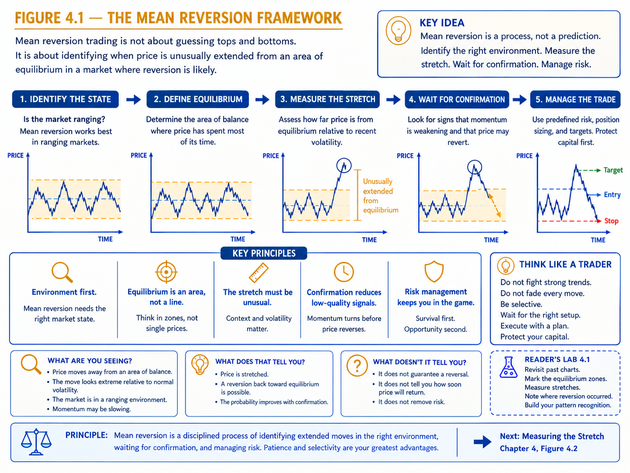
One of the easiest mistakes in trading is confusing a large move with a trading opportunity. A market can fall sharply and continue falling. A market can rise aggressively and continue rising. The fact that price has moved a long way does not automatically create a mean reversion trade. This is where the work we did in the previous chapter becomes important.
We are no longer asking only:
"How to spot a stretched market"
We are asking:
“Has price moved a long way within an environment that is suitable for mean reversion?
That is a much better question.
Because a stretched market inside a range is often a very different situation from a stretched market inside a strong trend.
A stretched market is relative
When I first began studying mean reversion, I kept looking for fixed numbers.
How many points is too far?
What percentage move is extreme?
The market quickly taught me that there is no universal answer.
A 100-point move may be insignificant in one market and extraordinary in another.
A move that is normal during a volatile period may be highly unusual during a quiet period.
Stretch is relative.
Relative to recent behaviour.
Relative to volatility.
Relative to the market environment.
This is why observation comes first.
The eye usually notices it first
Before looking at indicators, I often ask a simple question:
Does this move look different from the recent moves around it?
Experienced traders often notice stretch visually before they can explain it.
The goal is to make that observation more systematic.
Get the E-book Here